Research

Visual and Multimodal Political Communication
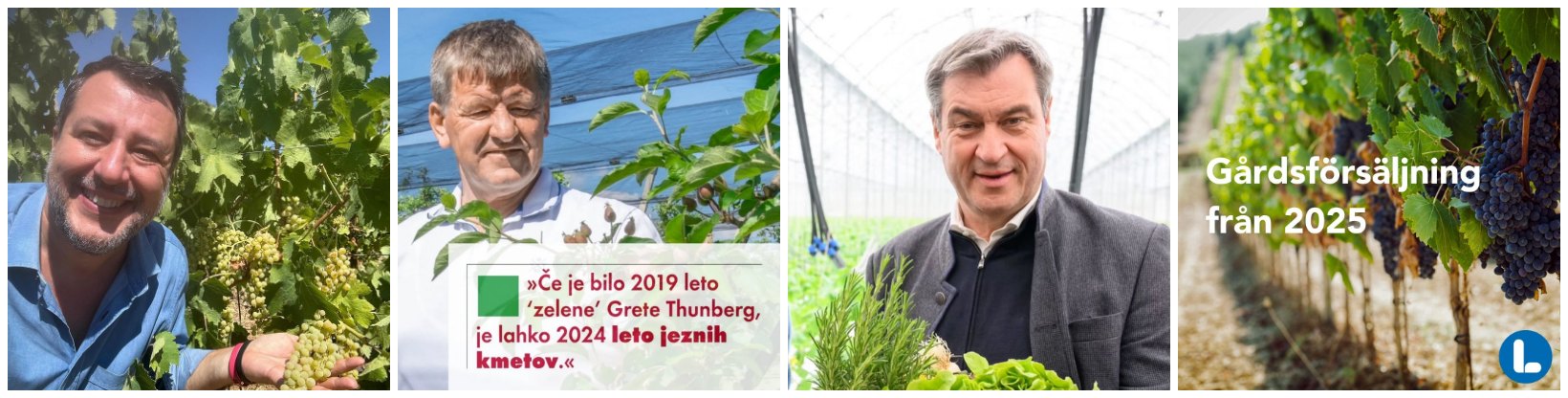
A campaign post (left) and the three most similar posts among those published by European parties on Instagram, measured with image embeddings from a vision model.

Images have become one of the main ways in which parties and leaders speak to voters. On platforms such as Instagram, a single picture can signal who a party is, what it stands for and whom it speaks to, often faster and more ambiguously than words. This project studies how political actors use visual and multimodal communication strategically, and what these choices mean for party competition and democratic representation. Much of this work started within the PRIN project VIPoP — The Visual Politics of Populism.

A central concern is how parties manage the tension between recognizability and appeal. Parties with strong or controversial identities, such as the populist radical right, need to stay recognizable to their core supporters while looking acceptable to wider audiences. Images allow them to do both at once, combining ideological markers with softer signals of ordinariness, proximity or competence within the same frame. We study how such combinations are organized across a party’s communication, whether party families converge on distinctive visual repertoires, and how images and text work together, reinforcing or departing from each other.

The project also develops computational tools to study visual content at scale. We combine image embeddings from vision models, automated descriptions produced by vision-language models, topic models and human coding, and apply them to tens of thousands of social media posts by parties and candidates across Europe.

Related work

  1. Mobilizing Past and Future: Radical Right Candidates and Citizens
    G. Pagano (2026)
    Work in progress
  2. More than words? Understanding Multimodal Political Communication: a Computational Analysis of Textual and Visual Elements in the EP 2024 Campaign
    G. Pagano, L. Curini (2026)
    Under Review

Executive Power in EU Legislation, 1958–2019

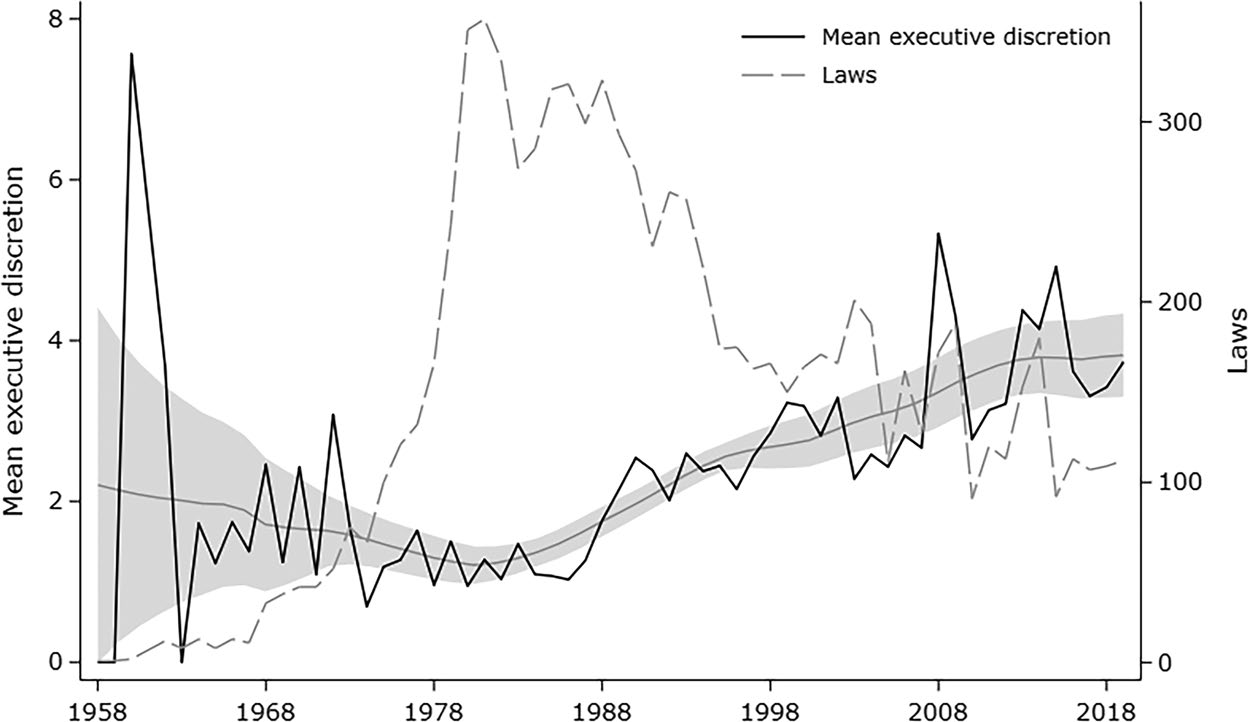
The Commission’s mean executive discretion (solid line) and the number of laws adopted each year (dashed), 1958–2019. From Franchino, Migliorati & Pagano (2026), West European Politics.

Laws are where legislators decide who governs and on what terms. Each directive or regulation assigns powers to executive actors (the Commission, supranational agencies, member states, national authorities) and sets limits on how those powers can be used. With Fabio Franchino and Marta Migliorati, I study this architecture of executive power across more than six decades of EU legislation.

The agenda rests on a new way of measuring it. Together with Valerio Vignoli, we built a transparent, rule-based pipeline that reads the syntax legislators use to delegate and to constrain, and applied it to more than 600,000 sentences from 9,319 directives and regulations adopted between 1958 and 2019. The pipeline closely matches human coders, outperforms fine-tuned transformer models, and yields the most comprehensive measures of delegation and constraint in the EU to date.

With these data we revisit core questions about European integration. We show why counting how often legislators constrain, rather than how many kinds of constraint they use, better captures their intent to control implementation. We find that the steady empowerment of the European Commission rests on a supranational alliance with the European Parliament, strongest when the two are ideologically close. And we trace where the obligations that EU law imposes on member states come from, and how much flexibility those states retain.

Related work

  1. F. Franchino, M. Migliorati, G. Pagano (2026)
    West European Politics
  2. The sources of national obligations and flexibility in European Union legislative acts (1979–2019)
    F. Franchino, M. Migliorati, G. Pagano (2026)
    European Journal of Political ResearchForthcoming
  3. F. Franchino, M. Migliorati, G. Pagano, V. Vignoli (2026)
    European Union Politics
  4. Bending Bureaucracy: Detecting Political Capture of Administration with Computational Legislative Analysis
    A. Damonte, G. Pagano (2026)
    Work in progress
  5. F. Franchino, M. Migliorati, G. Pagano, V. Vignoli (2024)
    Regulation & Governance, (3), 688–703

The Language and Limits of Democratic Support

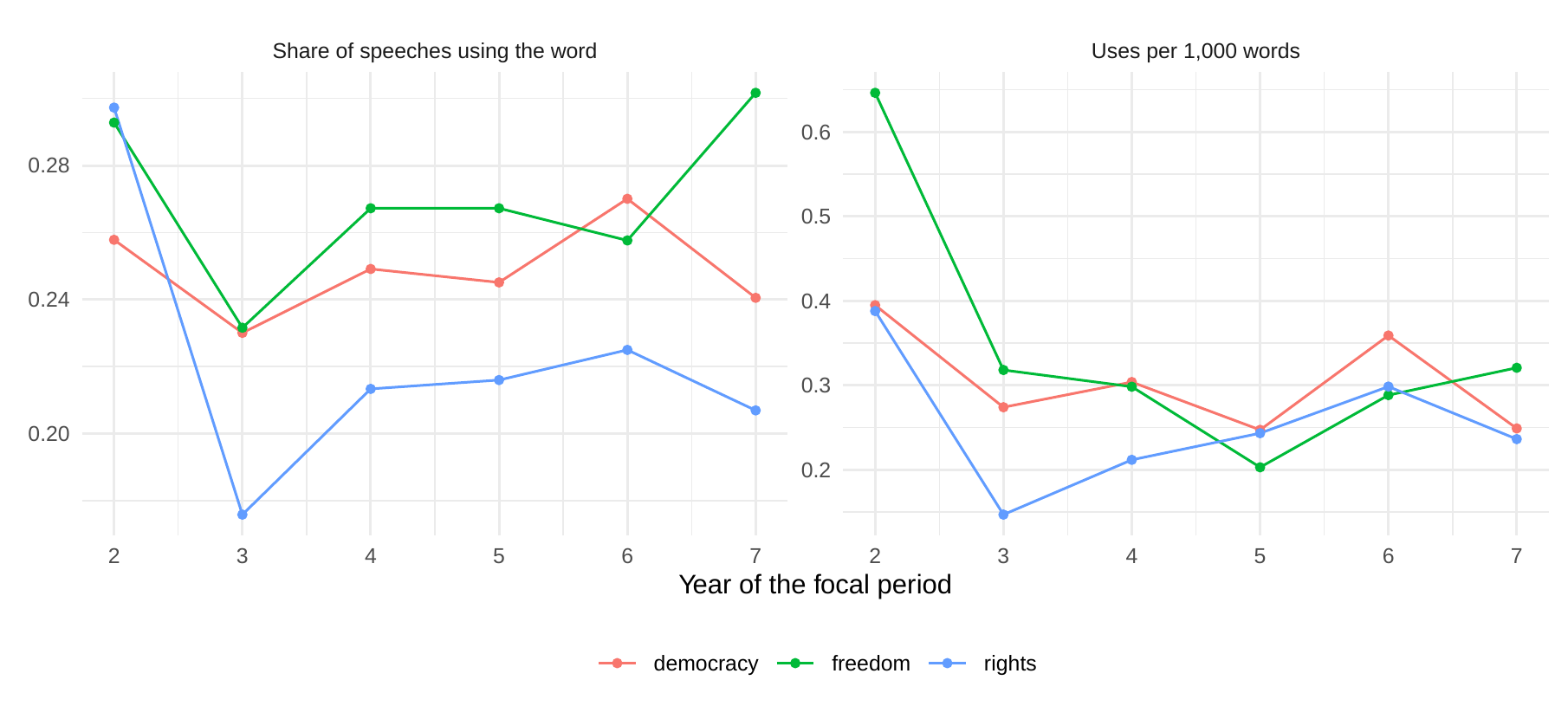
How often autocratizing leaders use “democracy”, “freedom” and “rights” in their speeches, over the course of autocratization. Corda & Pagano, work in progress.

Democracies today rarely collapse in a single blow. More often they erode gradually, at the hands of elected leaders who keep the outward forms of democracy while hollowing out its substance. This project studies that process from two sides: how leaders talk about democracy while undermining it, and how citizens respond when democratic rights come under pressure.

With Tiziana Corda, I study the language of autocratizing leaders. Would-be autocrats seldom reject democracy openly; they invoke it to protect their legitimacy at home and abroad. Using word embeddings on a large corpus of political speeches, we trace whether core democratic concepts such as democracy, freedom and rights keep their meaning as autocratization deepens, or are gradually reframed in illiberal terms, and how ties to democratic partners shape this rhetoric.

With Margherita Bordignon and Francesco Piacentini, I turn to the demand side: when, and for whom, citizens are willing to accept restrictions on civil liberties, and what this reveals about the foundations of democratic support.

Related work

  1. Democratic rhetoric in autocratizing regimes
    G. Pagano, T. Corda (2026)
    Work in progress
  2. When democracies bend: Understanding Democratic Backsliding Through Citizens’ Attitudes
    M. Bordignon, G. Pagano, F. Piacentini (2025)
    Work in progress